Narrow by Grade

  • Infant (0)
  • Toddler (0)
  • Preschool (0)
  • 5th (0)
  • 6th & Up (0)

Grade

Narrow by Age

  • 0-18m (0)
  • 18-36m (0)
  • 3 yrs. (0)
  • 10 yrs. (0)
  • 11 yrs. & Up (0)

Age

5 results for "valentines"


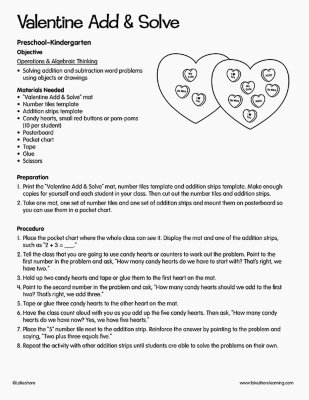
Valentine Add & Solve
Pre-K - Kindergarten

Objective Operations & Algebraic Thinking Solving addition and subtraction word problems using objects or drawings Materials Needed “Valentine Add & Solve” mat Number tiles template Addition strips template Candy hearts, small red buttons or pom-poms (10 per student) Posterboard Pocket chart Tape Glue Scissors Preparation Print the “Valentine Add & Solve” mat, number tiles template and addition strips template. Make enough copies for yourself and each student in your class. Then cut out the number tiles and addition strips. Take one mat, one set of number tiles and one set of addition strips and mount them on posterboard so you can use them in a pocket chart.

View Lesson Plan
Counting Hearts
Counting Hearts
Pre-K - Kindergarten

Objective CCSS Math/Counting and Cardinality (K.CC.5) Count to answer “how many?” questions about as many as 20 things arranged in a line, a rectangular array or a circle, or as many as 10 things in a scattered configuration; given a number from 1 - 20, count out that many objects. Materials Needed One Heart: A Valentine Counting Book by Maryann Cocca-Leffler Conversation candy hearts or paper hearts page Chart paper, whiteboard or document camera Conversation heart mat Number cards Zip-close plastic bags Candy jar mats and candy pieces Best-Buy Crayons Counting Hearts reproducible Fiskars Classroom Scissors Introduction Read aloud One Heart: A Valentine Counting Book by Maryann Cocca-Leffler. As you read, pause and ask students to help you count the hearts on each page.

View Lesson Plan
Rolling for Number Sense: Even and Odd Numbers
1st Grade - 2nd Grade

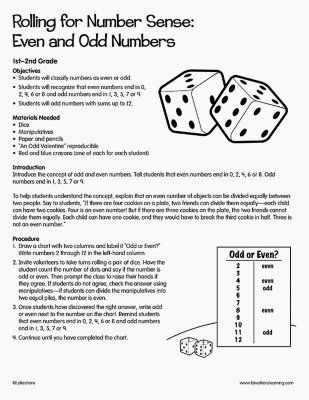
Objectives Students will classify numbers as even or odd. Students will recognize that even numbers end in 0, 2, 4, 6 or 8 and odd numbers end in 1, 3, 5, 7 or 9. Students will add numbers with sums up to 12. Materials Needed Dice Manipulatives Paper and pencils “An Odd Valentine” reproducible Red and blue crayons (one of each for each student) Introduction Introduce the concept of odd and even numbers. Tell students that even numbers end in 0, 2, 4, 6 or 8. Odd numbers end in 1, 3, 5, 7 or 9. To help students understand the concept, explain that an even number of objects can be divided equally between two people. Say to students, “If there are four cookies on a plate, two friends can divide them equally—each child can have two cookies. Four is an even number! But if there are three cookies on the plate, the two friends cannot divide them equally. Each child can have one cookie, and they would have to break the third cookie in half. Three is not an even number.”

View Lesson Plan
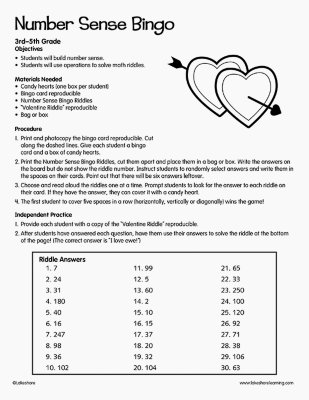
Number Sense Bingo
Number Sense Bingo
3rd Grade - 4th Grade

Objectives Students will build number sense. Students will use operations to solve math riddles. Materials Needed Candy hearts (one box per student) Bingo card reproducible Number Sense Bingo Riddles “Valentine Riddle” reproducible Bag or box

View Lesson Plan

The Heart of a Story: Characters, Setting and Events
1st Grade - 2nd Grade

Objectives Using illustrations and details in a story to describe its characters, setting or events Using information from illustrations and words to demonstrate understanding of characters, setting or plot Materials Needed Nate the Great and the Mushy Valentine by Marjorie Weinman Sharmat Story Elements chart Chart paper, chalkboard or document camera Marker or chalk Story Elements spinner Story Elements story and questions Pencils Paper clips Introduction Read aloud Nate the Great and the Mushy Valentine by Marjorie Weinman Sharmat.

View Lesson Plan