Playing with Push and Pull1st Grade - 2nd Grade
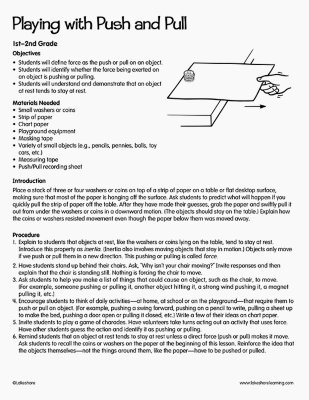
Objectives Students will define force as the push or pull on an object. Students will identify whether the force being exerted on an object is pushing or pulling. Students will understand and demonstrate that an object at rest tends to stay at rest. Materials Needed Small washers or coins Strip of paper Chart paper Playground equipment Masking tape Variety of small objects (e.g., pencils, pennies, balls, toy cars, etc.) Measuring tape Push/Pull recording sheet Introduction Place a stack of three or four washers or coins on top of a strip of paper on a table or flat desktop surface, making sure that most of the paper is hanging off the surface. Ask students to predict what will happen if you quickly pull the strip of paper off the table. After they have made their guesses, grab the paper and swiftly pull it out from under the washers or coins in a downward motion. (The objects should stay on the table.) Explain how the coins or washers resisted movement even though the paper below them was moved away. View Lesson Plan 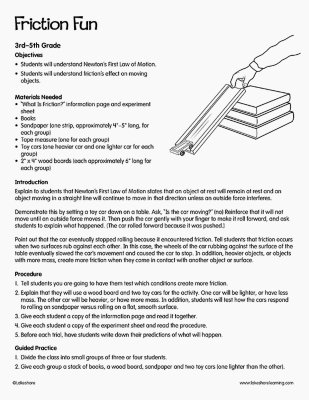
Friction Fun4th Grade
Objectives Students will understand Newton’s First Law of Motion. Students will understand friction’s effect on moving objects. Materials Needed “What Is Friction?” information page and experiment sheet Books Sandpaper (one strip, approximately 4" - 5" long, for each group) Tape measure (one for each group) Toy cars (one heavier car and one lighter car for each group) 2" x 4" wood boards (each approximately 6" long for each group) Introduction Explain to students that Newton’s First Law of Motion states that an object at rest will remain at rest and an object moving in a straight line will continue to move in that direction unless an outside force interferes. Demonstrate this by setting a toy car down on a table. Ask, “Is the car moving?” (no) Reinforce that it will not move until an outside force moves it. Then push the car gently with your finger to make it roll forward, and ask students to explain what happened. (The car rolled forward because it was pushed.) Point out that the car eventually stopped rolling because it encountered friction. Tell students that friction occurs when two surfaces rub against each other. In this case, the wheels of the car rubbing against the surface of the table eventually slowed the car’s movement and caused the car to stop. In addition, heavier objects, or objects with more mass, create more friction when they come in contact with another object or surface. View Lesson Plan Add It Up!Kindergarten
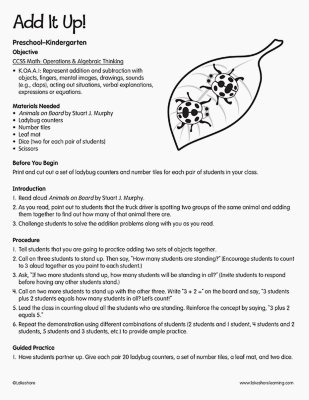
Objective CCSS Math: Operations & Algebraic Thinking K.OA.A.1: Represent addition and subtraction with objects, fingers, mental images, drawings, sounds (e.g., claps), acting out situations, verbal explanations, expressions or equations. Materials Needed Animals on Board by Stuart J. Murphy Ladybug counters Number tiles Leaf mat Dice (two for each pair of students) Scissors Introduction Read aloud Animals on Board by Stuart J. Murphy. As you read, point out to students that the truck driver is spotting two groups of the same animal and adding them together to find out how many of that animal there are. Challenge students to solve the addition problems along with you as you read. View Lesson Plan