"Back to School" Poem Booklets: An Introduction to Poems and StorytellingKindergarten
Objectives Recognizing common types of texts (e.g., storybooks, poems) Naming the author and illustrator of a story and defining the role of each in telling the story Recognizing and producing rhyming words Materials Needed Over in the Meadow by Olive A. Wadsworth with illustrations by Ezra Jack Keats Whiteboard, overhead projector, document camera or interactive whiteboard “Back to School” poem booklet Crayons Introduction Tell students that you are going to read a picture book called Over in the Meadow. Explain that the words are a poem that was written by author Olive A. Wadsworth. Point to the title page and indicate that the pictures were drawn by Ezra Jack Keats. Explain that adding pictures to the poem can help the reader understand more about what is happening in the story. Explain to students that authors, or writers, often write poems to communicate ideas or tell a whole story. Point out that many poems contain rhyming words and a certain rhythm to their sentences. Ask students to pay special attention to the rhythm of the poem and how some of the words rhyme. As you read, challenge students to find two words in the poem that rhyme. View Lesson Plan What Makes a Shadow?1st Grade
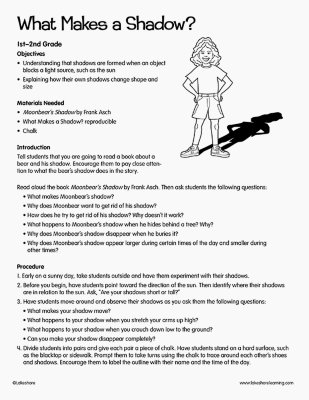
Objectives Understanding that shadows are formed when an object blocks a light source, such as the sun Explaining how their own shadows change shape and size Materials Needed Moonbear’s Shadow by Frank Asch What Makes a Shadow? reproducible Chalk Introduction Tell students that you are going to read a book about a bear and his shadow. Encourage them to pay close attention to what the bear’s shadow does in the story. Read aloud the book Moonbear’s Shadow by Frank Asch. Then ask students the following questions: What makes Moonbear’s shadow? Why does Moonbear want to get rid of his shadow? How does he try to get rid of his shadow? Why doesn’t it work? What happens to Moonbear’s shadow when he hides behind a tree? Why? Why does Moonbear’s shadow disappear when he buries it? Why does Moonbear’s shadow appear larger during certain times of the day and smaller during other times? View Lesson Plan 
Close Reading and Text Features3rd Grade - 4th Grade
Objectives CCSS Reading: Informational Text RI.3.7: Use information gained from illustrations (e.g., maps, photographs) and the words in a text to demonstrate understanding of the text (e.g., where, when, why, and how key events occur). RI.4.7: Interpret information presented visually, orally, or quantitatively (e.g., in charts, graphs, diagrams, time lines, animations, or interactive elements on Web pages) and explain how the information contributes to an understanding of the text in which it appears. Materials Needed “Three Cheers for Engineers!” reading passage Paper and pencils Introduction Provide students with a copy of the “Three Cheers for Engineers!” reading passage. Tell students, “Today we are going to read a passage titled, “Three Cheers for Engineers!” One practice of good readers is that they pay close attention to the text. As we read, I want you to think about the meaning of the text, the words that are used and other features on the page that are used to help interpret the text.” View Lesson Plan 
Same Story, Different Cultures1st Grade - 2nd Grade
Objectives CCSS Reading: Literature RL.2.1: Ask and answer such questions as who, what, where, when, why, and how to demonstrate understanding of key details in a text. RL.2.2: Recount stories, including fables and folk tales from diverse cultures, and determine their central message, lesson, or moral. RL.2.9: Compare and contrast two or more versions of the same story (e.g., Cinderella stories) by different authors or from different cultures. Materials Needed Any copy of Cinderella A copy of a Cinderella story from another culture, such as Yeh-Shen or The Rough-Face Girl Whiteboard or chart paper “The Tortoise and the Hare” “The Heron and the Hummingbird” Comparing Stories reproducible Introduction Tell students that you are going to read two different stories and then compare them to find similarities and differences. Ask students to pay special attention to the characters, the plot and the lesson that each story teaches. View Lesson Plan 
Literal vs. Nonliteral Meanings3rd Grade - 4th Grade
Objective CCSS Language/Vocabulary Acquisition and Use: L.3.5.a, L.4.5.b Demonstrate understanding of word relationships and nuances in word meanings: a. Distinguish the literal and nonliteral meanings of words and phrases in context (e.g., take steps). Demonstrate understanding of figurative language, word relationships and nuances in word meanings: b. Recognize and explain the meaning of common idioms. Materials Needed Amelia Bedelia by Peggy Parish Chart paper and marker or chalkboard and chalk or document camera Illustrating Idioms page Wrap-Around Language Idiom cards and answer key Markers or Crayons Best-Buy Scissors Before You Begin Explain to students that words or phrases can have literal or nonliteral meanings. Tell them that a nonliteral meaning is when a phrase means something other than the exact words in it. Explain that authors sometimes use nonliteral meanings in their writing as a way to make a comparison or an exaggerated statement about something. For example, an author writing that someone is a “night owl” is really saying that this person is awake and active at night (nonliteral meaning) rather than stating that the person turns into an animal at night (literal meaning). Tell students that you are going to read the story Amelia Bedelia by Peggy Parish. Ask students to actively listen for the idioms, or nonliteral phrases, that are used in the story. Introduction Begin reading aloud to the class Amelia Bedelia by Peggy Parish. As you read, pause to point out one or two forms of figurative language (e.g., “change the towels” on p. 16 or “draw the drapes” on p. 25) that cause confusion for Amelia. Ask students to explain and describe what they really mean, as opposed to Amelia’s literal interpretation of the phrases. Before you continue with the story, ask students to pay special attention to some of the other forms of figurative language in the story as Amelia encounters them. View Lesson Plan 
Beginning, Middle and EndPre-K - Kindergarten
Objectives Students will identify the beginning, middle and end of a story. Students will recall events of a story in the correct order. Materials Needed The book The Rainbow Fish by Marcus Pfister Chart paper and marker (or chalkboard and chalk) Construction Paper (12" x 18") Scissors Crayons Aluminum Foil Glue The Rainbow Fish Reproducible Introduction Ask students to raise their hands if they like it when their friends share things with them. Then ask them to raise their hands if they have ever owned something so special that they didn’t want to share it with others. Invite a few volunteers to talk about their prized possession. Finally, ask students, “How do you think your friends would feel if you never shared with them?” and, “How do you think you would feel if your friends didn?t share with you?” Tell students that you are going to read a book called The Rainbow Fish. Explain how the Rainbow Fish in the story has something special that he is not sure he wants to share. Invite students to pay close attention to the sequence of events in the story as you read it aloud. Ask them to think about what happens in the beginning, in the middle and at the end of the story. View Lesson Plan 
New Year’s Resolution1st Grade
Objectives Reading Literature Asking and answering questions about key details in a text Language Producing and expanding complete simple and compound declarative, interrogative, imperative, and exclamatory sentences Defining “New Year’s resolution” and helping to make appropriate class resolutions Writing Creating individual New Year’s resolutions Materials Needed Squirrel’s New Year’s Resolution by Pat Miller Chart paper or whiteboard New Year’s Resolution reproducible Tagboard Self-adhesive magnetic strips Safety Scissors Crayons or markers Glue Introduction Ask students to raise their hands if they have heard of making a New Year’s resolution. Invite them to share what they think a resolution is. Explain that you are going to read aloud a make-believe story about a squirrel who makes a New Year’s resolution. Ask students to pay special attention to the story to find out what a resolution is and why people might make them at the beginning of each year. View Lesson Plan Chinese Tangrams3rd Grade
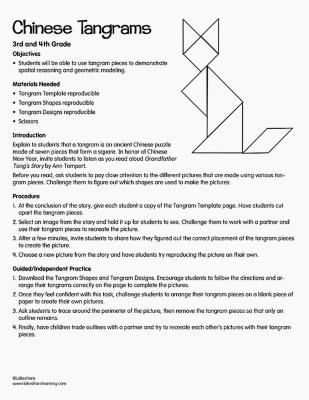
Objective Students will be able to use tangram pieces to demonstrate spatial reasoning and geometric modeling. Materials Needed Tangram Template Reproducible Tangram Shapes Reproducible Tangram Designs Reproducible Scissors Introduction Explain to students that a tangram is an ancient Chinese puzzle made of seven pieces that form a square. In honor of Chinese New Year, invite students to listen as you read aloud Grandfather Tang’s Story by Ann Tompert. Before you read, ask students to pay close attention to the different pictures that are made using various tangram pieces. Challenge them to figure out which shapes are used to make the pictures. View Lesson Plan 
Reading for Details1st Grade - 2nd Grade
Objectives CCSS Reading/Informational Text: Key Ideas and Details (RI.1.1, RI.1.2, RI.2.1, RI.2.2) Ask and answer questions about key details in a text. Identify the main topic and retell key details of a text. Ask and answer such questions as who, what, where, when, why and how to demonstrate understanding of key details in a text. Identify the main topic of a multiparagraph text as well as the focus of specific paragraphs within the text. Integration of Knowledge and Ideas (RI.1.7, RI.2.7) Use the illustrations and details in a text to describe its key ideas. Explain how specific images (e.g., a diagram showing how a machine works) contribute to and clarify a text. Materials Needed “Animal Homes” reading passage Reading for Details graphic organizer Document camera or whiteboard (optional) “Our Closest Star” reading passage Question frames Scissors Highlighters Introduction Explain to students that as they read about the ways animals build their homes, they can be “reading detectives” who discover the main topic and important details! To do this, they must read carefully, examine the text and pay close attention to illustrations that will help them find the answer to the following important questions: Where? When? How? Why? View Lesson Plan Parts of a PlantKindergarten
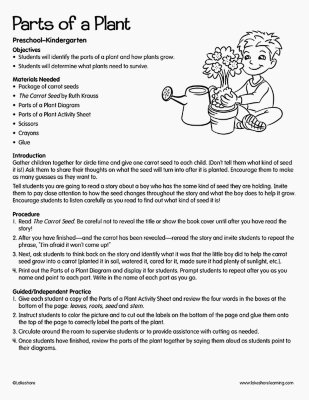
Objectives Students will identify the parts of a plant and how plants grow. Students will determine what plants need to survive. Materials Needed Package of carrot seeds The Carrot Seed by Ruth Krauss Parts of a Plant Diagram Parts of a Plant Activity Sheet Scissors Crayons Glue Introduction Gather children together for circle time and give one carrot seed to each child. (Don’t tell them what kind of seed it is!) Ask them to share their thoughts on what the seed will turn into after it is planted. Encourage them to make as many guesses as they want to. Tell students you are going to read a story about a boy who has the same kind of seed they are holding. Invite them to pay close attention to how the seed changes throughout the story and what the boy does to help it grow. Encourage students to listen carefully as you read to find out what kind of seed it is! View Lesson Plan Character Building: Bullying3rd Grade - 5th Grade
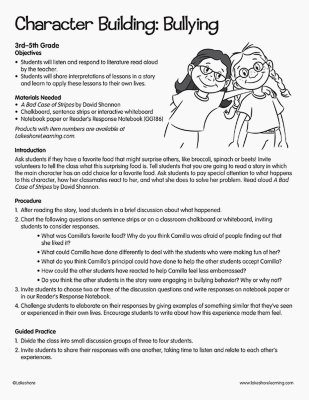
Objectives Students will listen and respond to literature read aloud by the teacher. Students will share interpretations of lessons in a story and learn to apply these lessons to their own lives. Materials Needed A Bad Case of Stripes by David Shannon Chalkboard, sentence strips or interactive whiteboard Notebook paper Introduction Ask students if they have a favorite food that might surprise others, like broccoli, spinach or beets! Invite volunteers to tell the class what this surprising food is. Tell students that you are going to read a story in which the main character has an odd choice for a favorite food. Ask students to pay special attention to what happens to this character, how her classmates react to her, and what she does to solve her problem. Read aloud A Bad Case of Stripes by David Shannon. View Lesson Plan