Fall Skip-Counting Fun1st Grade - 2nd Grade
Objectives Using strategies to add and subtract fluently within 20 Skip-counting by 2s, 5s, 10s and 100s Understanding that skip-counting is a faster way to count objects in a group Materials Needed Christopher Counting by Valeri Gorbachev Acorn Number Cards Counting by 2s Number Line Pumpkin Number Cards Counting by 5s Number Line Lakeshore Glue Sticks Fall Skip-Counting Fun Addition Practice Pointer or yardstick Scissors Introduction Read Christopher Counting by Valeri Gorbachev. Talk to the students about how excited the main character is about counting. Ask, “What are some objects that Christopher counted?” Then ask, “What are some objects that you can count?” Point out that Christopher was counting by 1s. Explain that students can count objects faster by skip-counting. View Lesson Plan 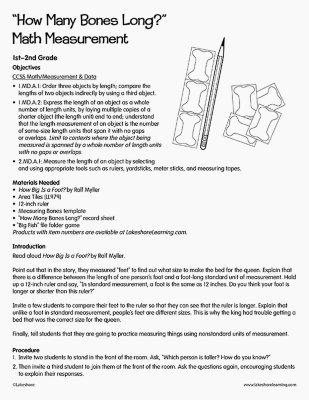
"How Many Bones Long?" Math Measurement1st Grade - 2nd Grade
Objectives CCSS Math/Measurement & Data 1.MD.A.1: Order three objects by length; compare the lengths of two objects indirectly by using a third object. 1.MD.A.2: Express the length of an object as a whole number of length units, by laying multiple copies of a shorter object (the length unit) end to end; understand that the length measurement of an object is the number of same-size length units that span it with no gaps or overlaps. Limit to contexts where the object being measured is spanned by a whole number of length units with no gaps or overlaps. 2.MD.A.1: Measure the length of an object by selecting and using appropriate tools such as rulers, yardsticks, meter sticks, and measuring tapes. Materials Needed How Big Is a Foot? by Rolf Myller Area Tiles 12-inch ruler Measuring Bones template “How Many Bones Long?” record sheet “Big Fish” file folder game Introduction Read aloud How Big Is a Foot? by Rolf Myller. Point out that in the story, they measured “feet” to find out what size to make the bed for the queen. Explain that there is a difference between the length of one person’s foot and a foot-long standard unit of measurement. Hold up a 12-inch ruler and say, “In standard measurement, a foot is the same as 12 inches. Do you think your foot is longer or shorter than this ruler?” Invite a few students to compare their feet to the ruler so that they can see that the ruler is longer. Explain that unlike a foot in standard measurement, people’s feet are different sizes. This is why the king had trouble getting a bed that was the correct size for the queen. Finally, tell students that they are going to practice measuring things using nonstandard units of measurement. View Lesson Plan 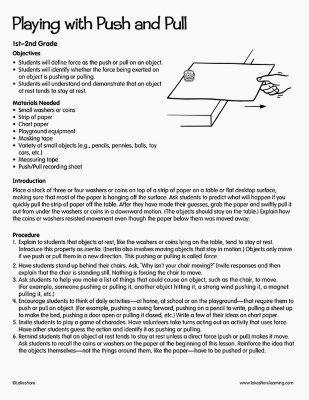
Playing with Push and Pull1st Grade - 2nd Grade
Objectives Students will define force as the push or pull on an object. Students will identify whether the force being exerted on an object is pushing or pulling. Students will understand and demonstrate that an object at rest tends to stay at rest. Materials Needed Small washers or coins Strip of paper Chart paper Playground equipment Masking tape Variety of small objects (e.g., pencils, pennies, balls, toy cars, etc.) Measuring tape Push/Pull recording sheet Introduction Place a stack of three or four washers or coins on top of a strip of paper on a table or flat desktop surface, making sure that most of the paper is hanging off the surface. Ask students to predict what will happen if you quickly pull the strip of paper off the table. After they have made their guesses, grab the paper and swiftly pull it out from under the washers or coins in a downward motion. (The objects should stay on the table.) Explain how the coins or washers resisted movement even though the paper below them was moved away. View Lesson Plan 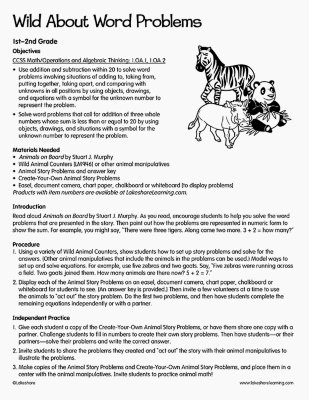
Wild About Word Problems1st Grade - 2nd Grade
Objectives CCSS Math/Operations and Algebraic Thinking: 1.OA.1, 1.OA.2 Use addition and subtraction within 20 to solve word problems involving situations of adding to, taking from, putting together, taking apart, and comparing with unknowns in all positions by using objects, drawings, and equations with a symbol for the unknown number to represent the problem. Solve word problems that call for addition of three whole numbers whose sum is less than or equal to 20 by using objects, drawings, and situations with a symbol for the unknown number to represent the problem. Materials Needed Animals on Board by Stuart J. Murphy Wild Animal Counters or other animal manipulatives Animal Story Problems and answer key Create-Your-Own Animal Story Problems Easel, document camera, chart paper, chalkboard or whiteboard [to display problems] Introduction Read aloud Animals on Board by Stuart J. Murphy. As you read, encourage students to help you solve the word problems that are presented in the story. Then point out how the problems are represented in numeric form to show the sum. For example, you might say, “There were three tigers. Along came two more. 3 + 2 = how many?” View Lesson Plan 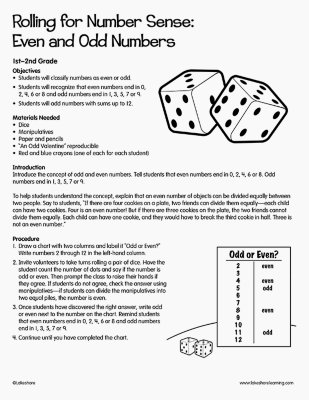
Rolling for Number Sense: Even and Odd Numbers1st Grade - 2nd Grade
Objectives Students will classify numbers as even or odd. Students will recognize that even numbers end in 0, 2, 4, 6 or 8 and odd numbers end in 1, 3, 5, 7 or 9. Students will add numbers with sums up to 12. Materials Needed Dice Manipulatives Paper and pencils “An Odd Valentine” reproducible Red and blue crayons (one of each for each student) Introduction Introduce the concept of odd and even numbers. Tell students that even numbers end in 0, 2, 4, 6 or 8. Odd numbers end in 1, 3, 5, 7 or 9. To help students understand the concept, explain that an even number of objects can be divided equally between two people. Say to students, “If there are four cookies on a plate, two friends can divide them equally—each child can have two cookies. Four is an even number! But if there are three cookies on the plate, the two friends cannot divide them equally. Each child can have one cookie, and they would have to break the third cookie in half. Three is not an even number.” View Lesson Plan Animal Adaptations1st Grade - 2nd Grade
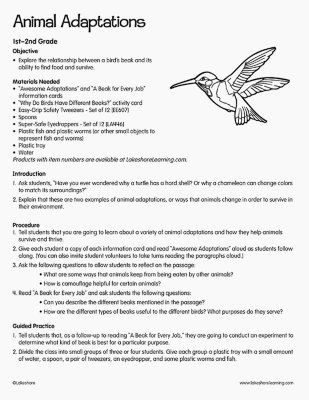
Objective Explore the relationship between a bird’s beak and its ability to find food and survive. Materials Needed “Awesome Adaptations” and “A Beak for Every Job” information cards “Why Do Birds Have Different Beaks?” activity card Easy-Grip Safety Tweezers - Set of 12 Spoons Super-Safe Eyedroppers - Set of 12 Plastic fish and plastic worms (or other small objects to represent fish and worms) Plastic tray Water Introduction Ask students, “Have you ever wondered why a turtle has a hard shell? Or why a chameleon can change colors to match its surroundings?” Explain that these are two examples of animal adaptations, or ways that animals change in order to survive in their environment. View Lesson Plan 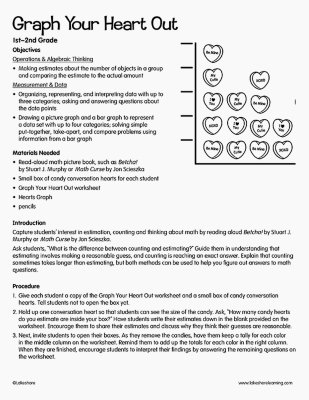
Graph Your Heart Out1st Grade - 2nd Grade
Objectives Operations & Algebraic Thinking Making estimates about the number of objects in a group and comparing the estimate to the actual amount Measurement & Data Organizing, representing, and interpreting data with up to three categories; asking and answering questions about the data points Drawing a picture graph and a bar graph to represent a data set with up to four categories; solving simple put-together, take-apart, and compare problems using information from a bar graph Materials Needed Read-aloud math picture book, such as Betcha! by Stuart J. Murphy or Math Curse by Jon Scieszka Small box of candy conversation hearts for each student Graph Your Heart Out worksheet Hearts Graph pencils Introduction Capture students’ interest in estimation, counting and thinking about math by reading aloud Betcha! by Stuart J. Murphy or Math Curse by Jon Scieszka. Ask students, “What is the difference between counting and estimating?” Guide them in understanding that estimating involves making a reasonable guess, and counting is reaching an exact answer. Explain that counting sometimes takes longer than estimating, but both methods can be used to help you figure out answers to math questions. View Lesson Plan 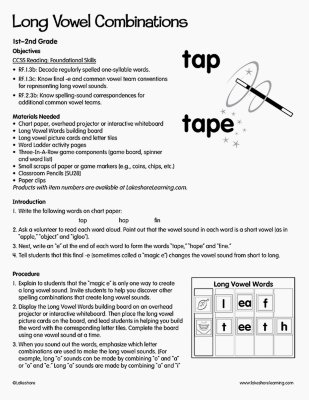
Long Vowel Combinations1st Grade - 2nd Grade
Objectives CCSS Reading: Foundational Skills RF.1.3b: Decode regularly spelled one-syllable words. RF.1.3c: Know final -e and common vowel team conventions for representing long vowel sounds. RF.2.3b: Know spelling-sound correspondences for additional common vowel teams. Materials Needed Chart paper, overhead projector or interactive whiteboard Long Vowel Words building board Long vowel picture cards and letter tiles Word Ladder activity pages Three-In-A-Row game components (game board, spinner and word list) Small scraps of paper or game markers (e.g., coins, chips, etc.) Classroom Pencils Paper clips Introduction Write the following words on chart paper: tap hop fin Ask a volunteer to read each word aloud. Point out that the vowel sound in each word is a short vowel (as in “apple,” “object” and “igloo”). Next, write an “e” at the end of each word to form the words “tape,” “hope” and “fine.” Tell students that this final -e (sometimes called a “magic e”) changes the vowel sound from short to long. View Lesson Plan Peppermint Parts: A Fraction Lesson2nd Grade
Objective Students will explore beginning fractions by dividing a whole into two equal parts, three equal parts and four equal parts. Materials Needed Sheila Rae’s Peppermint Stick by Kevin Henkes Peppermint Stick Fraction Bars reproducible Construction Paper - 9" x 12" (red and white) Scissors Glue Sticks Red and black markers or crayons Peppermint sticks (optional) Preparation: Print out a copy of the Peppermint Stick Fraction Bars reproducible onto white construction paper (or printer paper) for each student. Introduction Ask the class to think about ways to divide an object into two equal parts, or halves. As you read aloud Sheila Rae’s Peppermint Stick by Kevin Henkes, prompt students to listen for the solution that Sheila Rae uses to solve her problem. View Lesson Plan