Ants Go Marching3rd Grade
Objectives CCSS Math/Operations & Algebraic Thinking 3.OA.A.1: Interpret the products of whole numbers, e.g., interpret 5 x 7 as the total number of objects in 5 groups of 7 objects each. For example, describe a context in which a total number of objects can be expressed as 5 x 7. 3.OA.A.2: Interpret whole-number quotients of whole numbers, e.g., interpret 56 ÷ 8 as the number of objects in each share when 56 objects are partitioned equally into 8 shares, or as a number of shares when 56 objects are partitioned into equal shares of 8 objects each. For example, describe a context in which a number of shares or a number of groups can be expressed as 56 ÷ 8. 3.OA.A.3: Use multiplication and division within 100 to solve word problems in situations involving equal groups, arrays and measurement quantities, e.g., by using drawings and equations with a symbol for the unknown number to represent the problem. Materials Needed One Hundred Hungry Ants by Elinor Pinczes Ant counters or raisins Multiplication activity cards Ants Go Marching multiplication page (multiple copies for each student) Introduction Read aloud One Hundred Hungry Ants by Elinor Pinczes. View Lesson Plan 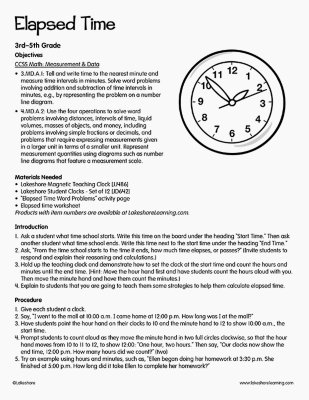
Elapsed Time3rd Grade - 4th Grade
Objectives CCSS Math: Measurement & Data 3.MD.A.1: Tell and write time to the nearest minute and measure time intervals in minutes. Solve word problems involving addition and subtraction of time intervals in minutes, e.g., by representing the problem on a number line diagram. 4.MD.A.2: Use the four operations to solve word problems involving distances, intervals of time, liquid volumes, masses of objects, and money, including problems involving simple fractions or decimals, and problems that require expressing measurements given in a larger unit in terms of a smaller unit. Represent measurement quantities using diagrams such as number line diagrams that feature a measurement scale. Materials Needed Lakeshore Magnetic Teaching Clock Lakeshore Student Clocks - Set of 12 “Elapsed Time Word Problems” activity page Elapsed time worksheet Introduction Ask a student what time school starts. Write this time on the board under the heading “Start Time.” Then ask another student what time school ends. Write this time next to the start time under the heading “End Time.” Ask, “From the time school starts to the time it ends, how much time elapses, or passes?” (Invite students to respond and explain their reasoning and calculations.) Hold up the teaching clock and demonstrate how to set the clock at the start time and count the hours and minutes until the end time. (Hint: Move the hour hand first and have students count the hours aloud with you. Then move the minute hand and have them count the minutes.) Explain to students that you are going to teach them some strategies to help them calculate elapsed time. View Lesson Plan Candy Coordinate Graphs3rd Grade
Objectives Students will form an ordered pair using two numbers. Students will use ordered pairs to locate points on a graph. Materials Needed Candy Coordinate Graph reproducible Dice (one pair per student) Mini candy bars Small candy pieces (such as candy corn or candy-coated chocolate) Tape Preparation: Draw a large version of the Candy Coordinate Graph reproducible on posterboard or the whiteboard. Use tape to attach mini candy bars to various points on the graph. Introduction Discuss with students that grids and graphs have a variety of uses in architecture, geography, and geometry. Explain that coordinates are used to indicate where a certain object or place is located on a graph. Draw a simple coordinate graph on the board and write the ordered pair (1, 4). Then demonstrate how to plot that point on the grid. View Lesson Plan 
