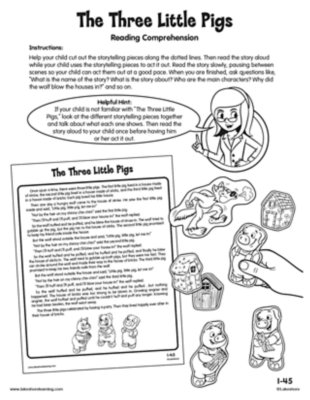
The Three Little Pigs
1st Grade
When entering first grade, your child should be able to listen to a story and answer questions about key details, such as identifying characters and events and retelling the story in their own words. Your child should also be able to identify parts of a book—such as the front cover, back cover and title page—as well as the role of authors and illustrators.
View worksheet
Animal Migration
2nd Grade
During second grade, your child will analyze fiction and nonfiction texts—identifying elements such as main ideas, key details and the author’s purpose.
View worksheet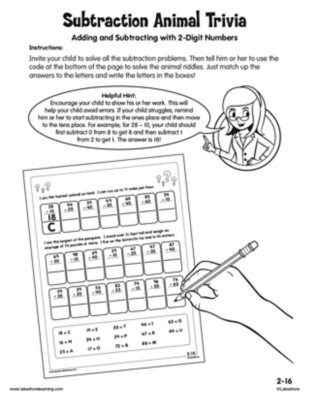
Subtraction Animal Trivia
2nd Grade
When entering second grade, your child should be able to add and subtract using a two-digit number and a one-digit number, as well as a two-digit number and another two-digit number. For example, 22 + 20 = 42 and 41 — 10 = 31.
View worksheet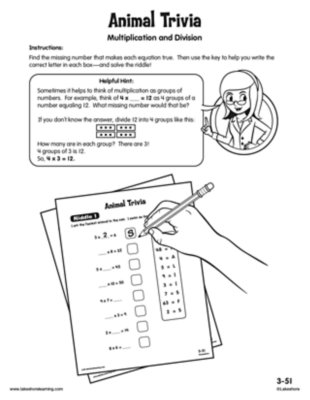
Animal Trivia
3rd Grade
During third grade, your child will learn to quickly and easily solve multiplication and division facts within 100 without having to count. For example, 9 x 9 = 81 and 56 ÷ 8 = 7.
View worksheet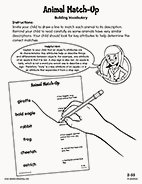
Animal Match-Up
2nd Grade
When entering second grade, your child should be able to define words by category and key attributes. For example, “A duck is a bird that swims.”
View worksheet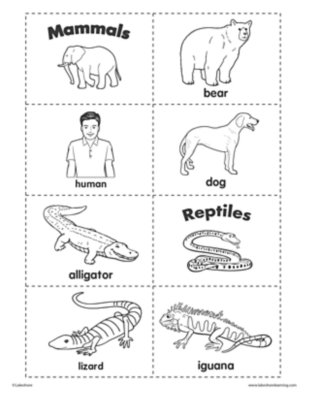
What’s the Meaning?
2nd Grade
When entering second grade, your child should be able to figure out the correct meanings of multiple-meaning words, such as knowing when the word “bat” refers to a baseball bat or a flying animal.
View worksheet
Definition Match
2nd Grade
When entering second grade, your child should be able to figure out the correct meanings of multiple-meaning words, such as knowing when the word “bat” refers to a baseball bat or a flying animal.
View worksheet
What’s the Word?
4th Grade
During fourth grade, your child will be asked to figure out the correct meanings of multiple-meaning words that appear in fourth-grade texts, such as knowing when the word “pitcher” refers to a container for pouring liquids or a person throwing a ball.
View worksheet
Meaning Match
4th Grade
During fourth grade, your child will be asked to figure out the correct meanings of multiple-meaning words that appear in fourth-grade texts, such as knowing when the word “pitcher” refers to a container for pouring liquids or a person throwing a ball.
View worksheet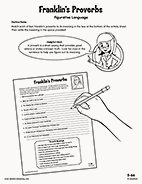
Franklin’s Proverbs
5th Grade
During fifth grade, your child will learn to interpret examples of figurative language, including similes and metaphors, based on the context in which they are used. Your child will also learn to recognize and explain the meaning of common idioms and familiar sayings and expressions, such as, “A bird in the hand is worth two in the bush.”
View worksheet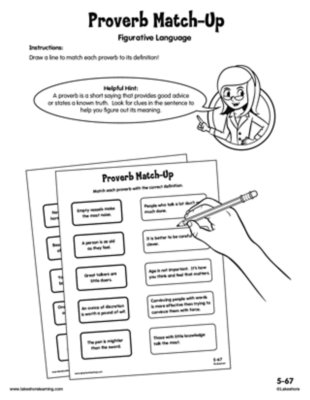
Proverb Match-Up
5th Grade
During fifth grade, your child will learn to interpret examples of figurative language, including similes and metaphors, based on the context in which they are used. Your child will also learn to recognize and explain the meaning of common idioms and familiar sayings and expressions, such as, “A bird in the hand is worth two in the bush.”
View worksheet