Narrow by Grade
Grade
7 results for "puppet stand"
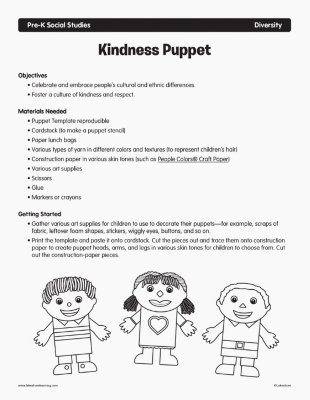
Kindness Puppet
Pre-K
Objectives
- Celebrate and embrace people’s cultural and ethnic differences.
- Foster a culture of kindness and respect.
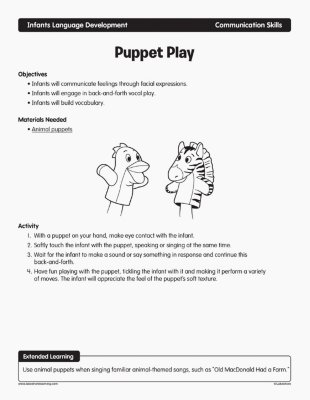
Puppet Play
Infant
Objectives
• Infants will communicate feelings through facial expressions.
• Infants will engage in back-and-forth vocal play.
• Infants will build vocabulary.
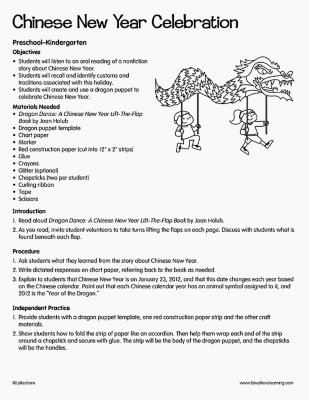
Chinese New Year Celebration
Pre-K - 1st Grade
Objectives Students will listen to an oral reading of a nonfiction story about Chinese New Year. Students will recall and identify customs and traditions associated with this holiday. Students will create and use a dragon puppet to celebrate Chinese New Year. Materials Needed Dragon Dance: A Chinese New Year Lift-The-Flap Book by Joan Holub Dragon puppet template Chart paper Marker Red construction paper (cut into 12" x 2" strips) Glue Crayons Glitter (optional) Chopsticks (two per student) Curling ribbon Tape Scissors Introduction Read aloud Dragon Dance: A Chinese New Year Lift-the-Flap Book by Joan Holub. As you read, invite student volunteers to take turns lifting the flaps on each page. Discuss with students what is found beneath each flap.
View Lesson Plan
Citizenship: Flag Day
2nd Grade
Objectives Identify and explain the meaning of national symbols (the American flag). Recite the Pledge of Allegiance and explain its general meaning. Materials Needed Pledge of Allegiance F Is for Flag by Wendy Cheyette Lewison Pencils Dictionaries (one for each pair of students) Introduction Invite students to stand and recite the Pledge of Allegiance aloud with you. Explain to students that to “pledge allegiance” to something means that you promise to be loyal to it. Ask, “Why do you think we say these words, promising to be loyal to our country’s flag? What is special about our country’s flag and what it represents?” Tell students that you are going to read aloud a story about the American flag and you would like them to listen for some explanations of what it represents to the United States of America.
View Lesson Plan
Menu Math
3rd Grade - 4th Grade
Objectives CCSS Math: Operations & Algebraic Thinking 3.OA.D.8: Solve two-step word problems using the four operations. Represent these problems using equations with a letter standing for the unknown quantity. Assess the reasonableness of answers using mental computation and estimation strategies including rounding. 4.OA.A.3: Solve multistep word problems posed with whole numbers and having whole-number answers using the four operations, including problems in which remainders must be
View Lesson Plan
Familiar Storytelling
Kindergarten
Objectives CCSS Reading/Literature: RL.K.2, RL.K.3 With prompting and support, retell familiar stories, including key details. With prompting and support, identify characters, settings and major events in a story. Materials Needed Goldilocks and the Three Bears by Caralyn Buehner or The Three Bears by Paul Galdone Retelling a Story chart Goldilocks and the Three Bears finger-puppet cutouts Goldilocks and the Three Bears storyboard page Tape Chart Paper and marker or document camera or whiteboard Safety Scissors Best-Buy Crayons Recycled gloves (with finger sections) and Glue (optional) Other fairy tales and folk tales Storytelling Glove and Three Bears Storytelling Puppets (optional) Introduction Read aloud Goldilocks and the Three Bears by Caralyn Buehner or The Three Bears by Paul Galdone. As you read aloud, stop during parts of the text and point out specific story elements and details—such as the setting, the sizes of the bears, the description of Goldilocks and so on.
View Lesson Plan
Multistep Word Problems
3rd Grade
Objectives CCSS Math: Operations & Algebraic Thinking 3.OA.D.8: Solve two-step word problems using the four operations. Represent these problems using equations with a letter standing for the unknown quantity. Assess the reasonableness of answers using mental computation and estimation strategies including rounding. 4.OA.A.3: Solve multistep word problems posed with whole numbers and having whole-number answers using the four operations, including problems in which remainders must be interpreted. Represent these problems using equations with a letter standing for the unknown quantity. Assess the reasonableness of answers using mental computation and estimation strategies including rounding. Materials Needed Cardboard box or posterboard, cut into an outline of a bus (optional) Whiteboard or chart paper Tim’s Yard Work flyer Neighborhood Jobs reproducible Neighborhood Jobs Answer Key Preparation Print out a copy of the Tim’s Yard Work flyer and the Neighborhood Jobs reproducible for each student in your class. (You can also display the flyer on a document camera.) Introduction Instruct students to listen very carefully to the following story problem: Mr. Smith is driving a bus. At first, the bus has no passengers. At the first stop, 10 passengers get onto the bus. At the second stop, 2 passengers get off the bus. Then 4 passengers board the bus. At the third stop, half the passengers get off the bus. Pause for a few seconds. Then ask, “Now...what is the name of the bus driver?” Most students will likely react with surprise at this question, but a few will remember that you stated who was driving the bus at the beginning of the story problem. Affirm that the name of the bus driver is Mr. Smith. Ask students to raise their hands if they were calculating the number of passengers getting on and off the bus. Explain that, although this story problem was a riddle with a surprising twist at the end, those with their hands raised were actually calculating a multistep math problem that involved addition, subtraction and even division. Point out that this exercise is also a good example of why it is helpful to read the whole problem first in order to find out what information is needed to answer the question.
View Lesson Plan