Teaching Tangrams2nd Grade
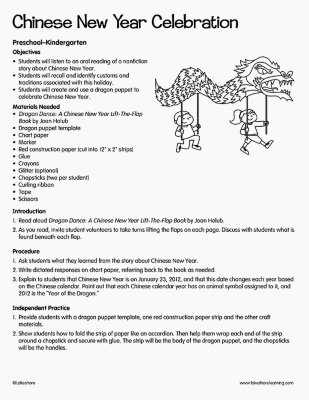
Objectives Students will identify and compare 2-D shapes. Students will understand the difference between congruent and similar shapes. Students will create and extend patterns. Students will combine shapes to create new shapes. Materials Needed Grandfather Tang’s Story: A Tale Told with Tangrams by Ann Tompert Tangrams template or Tangrams Tangram picture-matching cards or Tangram Picture Matching Cards Pattern blocks template or Pattern Blocks “Shapes Gallery” activity mat Scissors Paper & pencils Preparation: Print and copy the tangrams template, tangram picture-matching cards, pattern blocks template and “Shapes Gallery” activity mat. You will need one copy of each for each student. You can cut out the tangram shapes and pattern blocks in advance, or have students cut them out during the lesson. (You also can use the Pattern Blocks, Tangrams and Tangram Picture Matching Cards for this lesson.) Introduction Read aloud Grandfather Tang’s Story: A Tale Told with Tangrams. Show students the seven tangram shapes (two small triangles, two large triangles, one medium triangle, one square and one parallelogram). Tell students that tangrams originated in China. The story introduced only a few of the many shapes and figures that can be made with tangrams. View Lesson Plan Chinese New Year CelebrationPre-K - 1st Grade
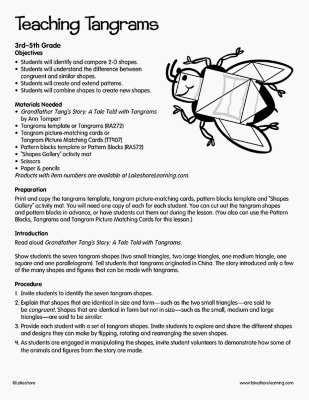
Objectives Students will listen to an oral reading of a nonfiction story about Chinese New Year. Students will recall and identify customs and traditions associated with this holiday. Students will create and use a dragon puppet to celebrate Chinese New Year. Materials Needed Dragon Dance: A Chinese New Year Lift-The-Flap Book by Joan Holub Dragon puppet template Chart paper Marker Red construction paper (cut into 12" x 2" strips) Glue Crayons Glitter (optional) Chopsticks (two per student) Curling ribbon Tape Scissors Introduction Read aloud Dragon Dance: A Chinese New Year Lift-the-Flap Book by Joan Holub. As you read, invite student volunteers to take turns lifting the flaps on each page. Discuss with students what is found beneath each flap. View Lesson Plan 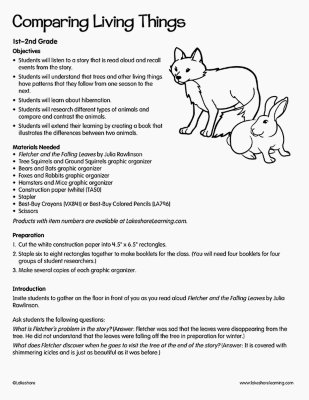
Comparing Living Things1st Grade
Objectives Students will listen to a story that is read aloud and recall events from the story. Students will understand that trees and other living things have patterns that they follow from one season to the next. Students will learn about hibernation. Students will research different types of animals and compare and contrast the animals. Students will extend their learning by creating a book that illustrates the differences between two animals. Materials Needed Fletcher and the Falling Leaves by Julia Rawlinson Tree Squirrels and Ground Squirrels graphic organizer Bears and Bats graphic organizer Foxes and Rabbits graphic organizer Hamsters and Mice graphic organizer Construction paper (white) Stapler Best-Buy Crayons or Best-Buy Colored Pencils Scissors Preparation Cut the white construction paper into 4.5" x 6.5" rectangles. Staple six to eight rectangles together to make booklets for the class. (You will need four booklets for four groups of student researchers.) Make several copies of each graphic organizer. Introduction Invite students to gather on the floor in front of you as you read aloud Fletcher and the Falling Leaves by Julia Rawlinson. Ask students the following questions: What is Fletcher’s problem in the story? (Answer: Fletcher was sad that the leaves were disappearing from the tree. He did not understand that the leaves were falling off the tree in preparation for winter.) What does Fletcher discover when he goes to visit the tree at the end of the story? (Answer: It is covered with shimmering icicles and is just as beautiful as it was before.) View Lesson Plan 
Writing a Persuasive Brochure3rd Grade - 5th Grade
Objectives Using reference materials to research for their writing Introducing the topic or text they are writing about, stating an opinion and creating an organizational structure that lists reasons Providing reasons that support the opinion Reporting on a topic or text, telling a story, or recounting an experience in an organized manner, using appropriate facts and relevant, descriptive details to support main ideas or themes; speaking clearly at an understandable pace Materials Needed Sample tourist pamphlets for exotic vacation destinations (available from local travel agents or hotels) Reference materials Travel Brochure reproducible Crayons or markers Glue (optional) Scissors (optional) Introduction Ask students, “If you could visit anywhere in the world, where would you go? What would you do there?” Invite students to share their responses. Encourage them to talk about places they have never been but would like to see. Prompt students to point out their destinations on a map. View Lesson Plan 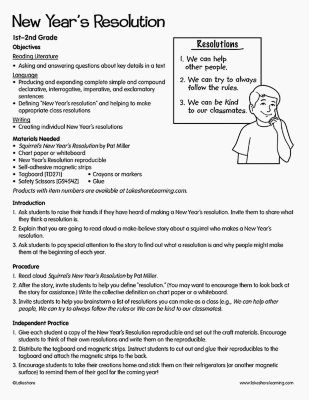
New Year’s Resolution1st Grade
Objectives Reading Literature Asking and answering questions about key details in a text Language Producing and expanding complete simple and compound declarative, interrogative, imperative, and exclamatory sentences Defining “New Year’s resolution” and helping to make appropriate class resolutions Writing Creating individual New Year’s resolutions Materials Needed Squirrel’s New Year’s Resolution by Pat Miller Chart paper or whiteboard New Year’s Resolution reproducible Tagboard Self-adhesive magnetic strips Safety Scissors Crayons or markers Glue Introduction Ask students to raise their hands if they have heard of making a New Year’s resolution. Invite them to share what they think a resolution is. Explain that you are going to read aloud a make-believe story about a squirrel who makes a New Year’s resolution. Ask students to pay special attention to the story to find out what a resolution is and why people might make them at the beginning of each year. View Lesson Plan 
Gingerbread GraphingPre-K
Objectives Students will create a picture graph and interpret the data on the graph. Students will use verbal clues and reasoning skills to solve riddles. Materials Needed The Gingerbread Man by Jim Aylesworth Gingerbread Man Hunt clues Gingerbread Man template Gingerbread Man Cookies reproducible Scissors Gingerbread Man cookies (one for each student) Cookie sheet Kitchen towel Tagboard or construction paper (brown) Tape Chart paper and marker Pom-Poms Peel & Stick Jewels Collage Buttons Glue Preparation: For the Gingerbread Man hunt: Work with other teachers and staff to set up a Gingerbread Man hunt around your school! Print out the Gingerbread Man Hunt clues. Distribute clues 2 - 6 to the teachers and staff in the clue locations. Explain that students will come to them for the clues, and they should pretend to have just seen the Gingerbread Man! Place the gingerbread cookies in the final location—the cafeteria or other eating area. (If you do not want to use real cookies, you can print and precut paper cookies using the Gingerbread Man Cookies reproducible.) Tape the first clue onto the cookie sheet and cover it with the kitchen towel. Set it aside. For the graphing activities: On chart paper, draw a graph with three columns. Along the bottom, label the columns from left to right: “Head,” “Arm,” and “Leg.” Title the graph “Which Part of the Gingerbread Man Did You Bite First?” Print copies of the Gingerbread Man Cookies reproducible. Cut out one paper cookie for each student. (If you decide to distribute paper cookies instead of real cookies at the end of the hunt, students can use those for the graphing activity.) Print the Gingerbread Man template and reproduce it onto brown tagboard or construction paper. You will need one for each student. Introduction Read aloud The Gingerbread Man by Jim Aylesworth. After the story, tell students that you have prepared a Gingerbread Man cookie for them to eat. (If you are not using real cookies, tell students you have made a paper cookie for them to use in a special math project.) Then take out the covered cookie sheet and pull off the towel. Act surprised as you announce, “Oh no, our Gingerbread Man has run away! Look, he left a note for us to read!” Read the clue aloud to students. View Lesson Plan