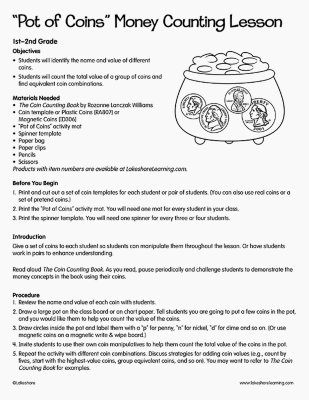
"Pot of Coins" Money Counting Lesson
2nd Grade
Objectives Students will identify the name and value of different coins. Students will count the total value of a group of coins and find equivalent coin combinations. Materials Needed The Coin Counting Book by Rozanne Lanczak Williams Coin template or Plastic Coins or Magnetic Coins “Pot of Coins” activity mat Spinner template Paper bag Paper clips Pencils Scissors Before You Begin Print and cut out a set of coin templates for each student or pair of students. (You can also use real coins or a set of pretend coins.) Print the “Pot of Coins” activity mat. You will need one mat for every student in your class. Print the spinner template. You will need one spinner for every three or four students. Introduction Give a set of coins to each student so students can manipulate them throughout the lesson. Or have students work in pairs to enhance understanding. Read aloud The Coin Counting Book. As you read, pause periodically and challenge students to demonstrate the money concepts in the book using their coins.
View Lesson Plan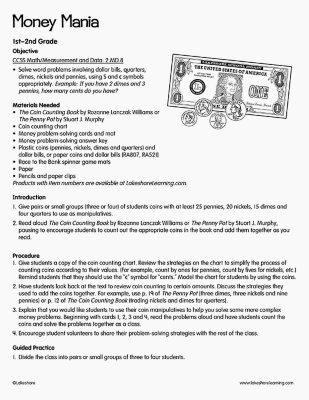
Money Mania
2nd Grade
Objective CCSS Math/Measurement and Data: 2.MD.8 Solve word problems involving dollar bills, quarters, dimes, nickels and pennies, using $ and ¢ symbols appropriately. Example: If you have 2 dimes and 3 pennies, how many cents do you have? Materials Needed The Coin Counting Book by Rozanne Lanczak Williams or The Penny Pot by Stuart J. Murphy Coin counting chart Money problem-solving cards and mat Money problem-solving answer key Plastic coins (pennies, nickels, dimes and quarters) and dollar bills, or paper coins and dollar bills Race to the Bank spinner game mats Paper Pencils and paper clips Introduction Give pairs or small groups (three or four) of students coins with at least 25 pennies, 20 nickels, 15 dimes and four quarters to use as manipulatives. Read aloud The Coin Counting Book by Rozanne Lanczak Williams or The Penny Pot by Stuart J. Murphy, pausing to encourage students to count out the appropriate coins in the book and add them together as you read.
View Lesson Plan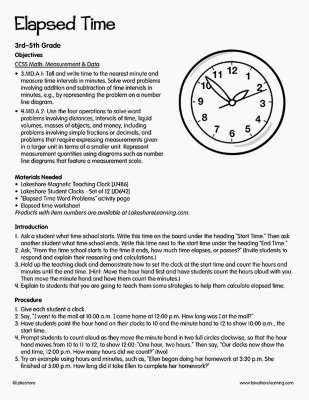
Elapsed Time
3rd Grade - 4th Grade
Objectives CCSS Math: Measurement & Data 3.MD.A.1: Tell and write time to the nearest minute and measure time intervals in minutes. Solve word problems involving addition and subtraction of time intervals in minutes, e.g., by representing the problem on a number line diagram. 4.MD.A.2: Use the four operations to solve word problems involving distances, intervals of time, liquid volumes, masses of objects, and money, including problems involving simple fractions or decimals, and problems that require expressing measurements given in a larger unit in terms of a smaller unit. Represent measurement quantities using diagrams such as number line diagrams that feature a measurement scale. Materials Needed Lakeshore Magnetic Teaching Clock Lakeshore Student Clocks - Set of 12 “Elapsed Time Word Problems” activity page Elapsed time worksheet Introduction Ask a student what time school starts. Write this time on the board under the heading “Start Time.” Then ask another student what time school ends. Write this time next to the start time under the heading “End Time.” Ask, “From the time school starts to the time it ends, how much time elapses, or passes?” (Invite students to respond and explain their reasoning and calculations.) Hold up the teaching clock and demonstrate how to set the clock at the start time and count the hours and minutes until the end time. (Hint: Move the hour hand first and have students count the hours aloud with you. Then move the minute hand and have them count the minutes.) Explain to students that you are going to teach them some strategies to help them calculate elapsed time.
View Lesson Plan