My Winter Acrostic3rd Grade - 5th Grade
Objectives Reading: Literature Reading and comprehending grade-appropriate literature, including stories, dramas, and poetry Writing Writing an acrostic poem Materials Needed Animal Acrostics by David Hummon or Autumn: An Alphabet Acrostic by Steven Schnur My Winter Acrostic template Winter Acrostic Organizer template Dark-blue construction paper - 9" x 12" Crayons or colored pencils Pencil Chalk or write & wipe marker Chalkboard or write & wipe board Introduction Hold up the book Animal Acrostics by David Hummon or Autumn: An Alphabet Acrostic by Steven Schnur. Then explain that the first letter of each line in an acrostic poem spells out a “topic” word that ties all the lines of the poem together. (It’s helpful to demonstrate the concept on a chalkboard or write & wipe board.) Read a few examples from the book and show students how acrostic poems are arranged on a page. (You may want to reproduce one on the board or a large poster so students can refer to it throughout the lesson.) View Lesson Plan Reduce, Reuse, Recycle!4th Grade
Objectives Students will match ecology vocabulary words to their corresponding definitions. Students will actively research ecology terms and demonstrate hands-on understanding of a variety of environmental issues that impact their community. Materials Needed Earth Book for Kids by Linda Schwartz Ecology Word and Meaning cards Pocket chart or bulletin board Scissors Pencils Reduce, Reuse, Recycle! graphic organizer Before You Begin Copy and cut out a set of Ecology Word and Meaning cards for each student. Make several copies of the Reduce, Reuse, Recycle! graphic organizer. Introduction As an introduction to Earth Day, read aloud Earth Book for Kids by Linda Schwartz. View Lesson Plan 
Friction Fun4th Grade
Objectives Students will understand Newton’s First Law of Motion. Students will understand friction’s effect on moving objects. Materials Needed “What Is Friction?” information page and experiment sheet Books Sandpaper (one strip, approximately 4" - 5" long, for each group) Tape measure (one for each group) Toy cars (one heavier car and one lighter car for each group) 2" x 4" wood boards (each approximately 6" long for each group) Introduction Explain to students that Newton’s First Law of Motion states that an object at rest will remain at rest and an object moving in a straight line will continue to move in that direction unless an outside force interferes. Demonstrate this by setting a toy car down on a table. Ask, “Is the car moving?” (no) Reinforce that it will not move until an outside force moves it. Then push the car gently with your finger to make it roll forward, and ask students to explain what happened. (The car rolled forward because it was pushed.) Point out that the car eventually stopped rolling because it encountered friction. Tell students that friction occurs when two surfaces rub against each other. In this case, the wheels of the car rubbing against the surface of the table eventually slowed the car’s movement and caused the car to stop. In addition, heavier objects, or objects with more mass, create more friction when they come in contact with another object or surface. View Lesson Plan 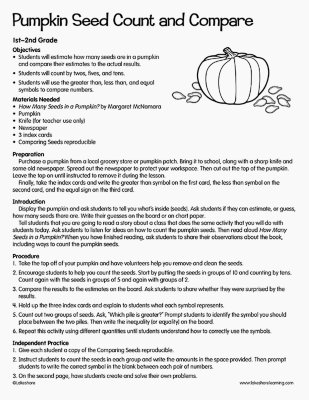
Pumpkin Seed Count and Compare1st Grade - 2nd Grade
Objectives Students will estimate how many seeds are in a pumpkin and compare their estimates to the actual results. Students will count by twos, fives, and tens. Students will use the greater than, less than and equal symbols to compare numbers. Materials Needed How Many Seeds in a Pumpkin? by Margaret McNamara Pumpkin Knife (for teacher use only) Newspaper 3 index cards Comparing Seeds reproducible Preparation: Purchase a pumpkin from a local grocery store or pumpkin patch. Bring it to school, along with a sharp knife and some old newspaper. Spread out the newspaper to protect your workspace. Then cut out the top of the pumpkin. Leave the top on until instructed to remove it during the lesson. Finally, take the index cards and write the greater than symbol on the first card, the less than symbol on the second card, and the equal sign on the third card. Introduction Display the pumpkin and ask students to tell you what’s inside (seeds). Ask students if they can estimate, or guess, how many seeds there are. Write their guesses on the board or on chart paper. Tell students that you are going to read a story about a class that does the same activity that you will do with students today. Ask students to listen for ideas on how to count the pumpkin seeds. Then read aloud How Many Seeds in a Pumpkin? When you have finished reading, ask students to share their observations about the book, including ways to count the pumpkin seeds. View Lesson Plan