Vocabulary Building: Animal Alliteration3rd Grade - 4th Grade
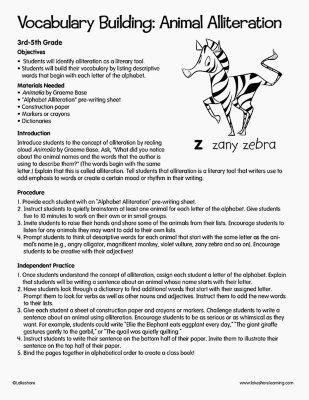
Objectives Students will identify alliteration as a literary tool. Students will build their vocabulary by listing descriptive words that begin with each letter of the alphabet. Materials Needed Animalia by Graeme Base “Alphabet Alliteration” pre-writing sheet Construction paper Markers or crayons Dictionaries Introduction Introduce students to the concept of alliteration by realing aloud Animalia by Graeme Base. Ask, “What did you notice about the animal names and the words that the author is using to describe them?” (The words begin with the same letter.) Explain that this is called alliteration. Tell students that alliteration is a literary tool that writers use to add emphasis to words or create a certain mood or rhythm in their writing. View Lesson Plan 
My Winter Acrostic3rd Grade - 5th Grade
Objectives Reading: Literature Reading and comprehending grade-appropriate literature, including stories, dramas, and poetry Writing Writing an acrostic poem Materials Needed Animal Acrostics by David Hummon or Autumn: An Alphabet Acrostic by Steven Schnur My Winter Acrostic template Winter Acrostic Organizer template Dark-blue construction paper - 9" x 12" Crayons or colored pencils Pencil Chalk or write & wipe marker Chalkboard or write & wipe board Introduction Hold up the book Animal Acrostics by David Hummon or Autumn: An Alphabet Acrostic by Steven Schnur. Then explain that the first letter of each line in an acrostic poem spells out a “topic” word that ties all the lines of the poem together. (It’s helpful to demonstrate the concept on a chalkboard or write & wipe board.) Read a few examples from the book and show students how acrostic poems are arranged on a page. (You may want to reproduce one on the board or a large poster so students can refer to it throughout the lesson.) View Lesson Plan 
Literal vs. Nonliteral Meanings3rd Grade - 4th Grade
Objective CCSS Language/Vocabulary Acquisition and Use: L.3.5.a, L.4.5.b Demonstrate understanding of word relationships and nuances in word meanings: a. Distinguish the literal and nonliteral meanings of words and phrases in context (e.g., take steps). Demonstrate understanding of figurative language, word relationships and nuances in word meanings: b. Recognize and explain the meaning of common idioms. Materials Needed Amelia Bedelia by Peggy Parish Chart paper and marker or chalkboard and chalk or document camera Illustrating Idioms page Wrap-Around Language Idiom cards and answer key Markers or Crayons Best-Buy Scissors Before You Begin Explain to students that words or phrases can have literal or nonliteral meanings. Tell them that a nonliteral meaning is when a phrase means something other than the exact words in it. Explain that authors sometimes use nonliteral meanings in their writing as a way to make a comparison or an exaggerated statement about something. For example, an author writing that someone is a “night owl” is really saying that this person is awake and active at night (nonliteral meaning) rather than stating that the person turns into an animal at night (literal meaning). Tell students that you are going to read the story Amelia Bedelia by Peggy Parish. Ask students to actively listen for the idioms, or nonliteral phrases, that are used in the story. Introduction Begin reading aloud to the class Amelia Bedelia by Peggy Parish. As you read, pause to point out one or two forms of figurative language (e.g., “change the towels” on p. 16 or “draw the drapes” on p. 25) that cause confusion for Amelia. Ask students to explain and describe what they really mean, as opposed to Amelia’s literal interpretation of the phrases. Before you continue with the story, ask students to pay special attention to some of the other forms of figurative language in the story as Amelia encounters them. View Lesson Plan Vocabulary Building: Using Context Clues3rd Grade - 4th Grade
Objectives Language Use sentence-level context as a clue to the meaning of a word or phrase. Use context (e.g., definitions, examples, or restatements in text) as a clue to the meaning of a word or phrase. Materials Needed Whiteboard and dry-erase marker (or chalkboard and chalk) Word Detective Activity reproducible Introduction In a low voice, say to students, “If you can hear me, please raise your snooble.” Students will likely giggle or give you a quizzical look, but simply repeat the instruction until one or two students begin raising their hands. Acknowledge their correct responses with a smile or nod. Once other students begin to catch on, confirm that the nonsense word “snooble” meant hand. Ask a volunteer to explain how she guessed the correct meaning of the nonsense word. View Lesson Plan Touch Threshold4th Grade
Objective
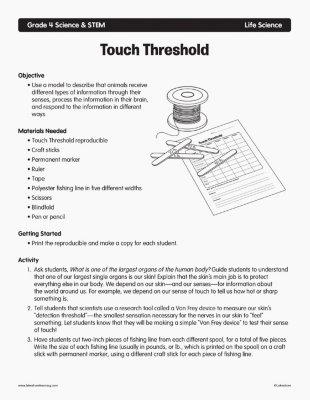
- Use a model to describe that animals receive different types of information through their senses, process the information in their brain, and respond to the information in different ways.
View Lesson Plan 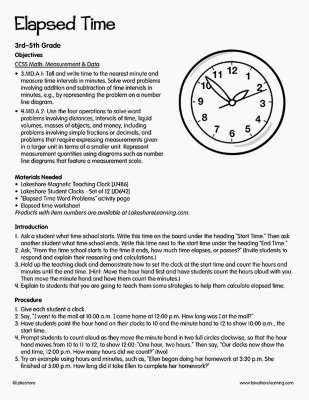
Elapsed Time3rd Grade - 4th Grade
Objectives CCSS Math: Measurement & Data 3.MD.A.1: Tell and write time to the nearest minute and measure time intervals in minutes. Solve word problems involving addition and subtraction of time intervals in minutes, e.g., by representing the problem on a number line diagram. 4.MD.A.2: Use the four operations to solve word problems involving distances, intervals of time, liquid volumes, masses of objects, and money, including problems involving simple fractions or decimals, and problems that require expressing measurements given in a larger unit in terms of a smaller unit. Represent measurement quantities using diagrams such as number line diagrams that feature a measurement scale. Materials Needed Lakeshore Magnetic Teaching Clock Lakeshore Student Clocks - Set of 12 “Elapsed Time Word Problems” activity page Elapsed time worksheet Introduction Ask a student what time school starts. Write this time on the board under the heading “Start Time.” Then ask another student what time school ends. Write this time next to the start time under the heading “End Time.” Ask, “From the time school starts to the time it ends, how much time elapses, or passes?” (Invite students to respond and explain their reasoning and calculations.) Hold up the teaching clock and demonstrate how to set the clock at the start time and count the hours and minutes until the end time. (Hint: Move the hour hand first and have students count the hours aloud with you. Then move the minute hand and have them count the minutes.) Explain to students that you are going to teach them some strategies to help them calculate elapsed time. View Lesson Plan Breathing Lung Model4th Grade
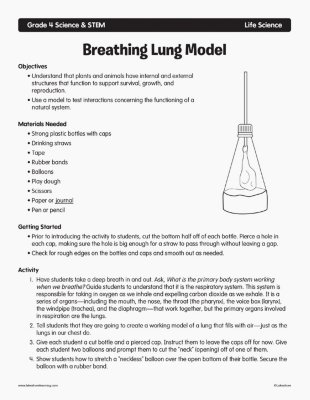
Objectives
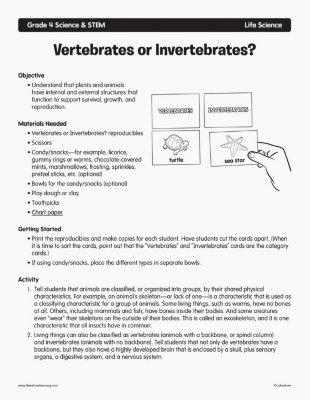
- Understand that plants and animals have internal and external structures that function to support survival, growth, and reproduction.
- Use a model to test interactions concerning the functioning of a natural system.
View Lesson Plan