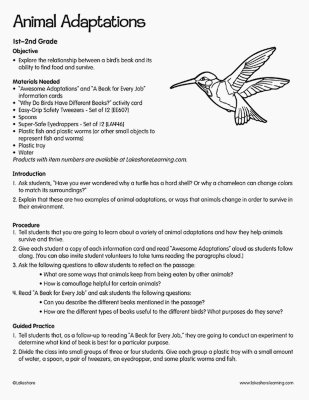
Animal Adaptations1st Grade - 2nd Grade
Objective Explore the relationship between a bird’s beak and its ability to find food and survive. Materials Needed “Awesome Adaptations” and “A Beak for Every Job” information cards “Why Do Birds Have Different Beaks?” activity card Easy-Grip Safety Tweezers - Set of 12 Spoons Super-Safe Eyedroppers - Set of 12 Plastic fish and plastic worms (or other small objects to represent fish and worms) Plastic tray Water Introduction Ask students, “Have you ever wondered why a turtle has a hard shell? Or why a chameleon can change colors to match its surroundings?” Explain that these are two examples of animal adaptations, or ways that animals change in order to survive in their environment. View Lesson Plan 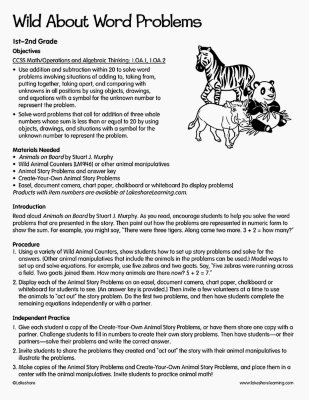
Wild About Word Problems1st Grade - 2nd Grade
Objectives CCSS Math/Operations and Algebraic Thinking: 1.OA.1, 1.OA.2 Use addition and subtraction within 20 to solve word problems involving situations of adding to, taking from, putting together, taking apart, and comparing with unknowns in all positions by using objects, drawings, and equations with a symbol for the unknown number to represent the problem. Solve word problems that call for addition of three whole numbers whose sum is less than or equal to 20 by using objects, drawings, and situations with a symbol for the unknown number to represent the problem. Materials Needed Animals on Board by Stuart J. Murphy Wild Animal Counters or other animal manipulatives Animal Story Problems and answer key Create-Your-Own Animal Story Problems Easel, document camera, chart paper, chalkboard or whiteboard [to display problems] Introduction Read aloud Animals on Board by Stuart J. Murphy. As you read, encourage students to help you solve the word problems that are presented in the story. Then point out how the problems are represented in numeric form to show the sum. For example, you might say, “There were three tigers. Along came two more. 3 + 2 = how many?” View Lesson Plan 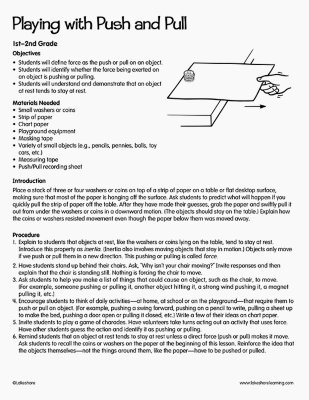
Playing with Push and Pull1st Grade - 2nd Grade
Objectives Students will define force as the push or pull on an object. Students will identify whether the force being exerted on an object is pushing or pulling. Students will understand and demonstrate that an object at rest tends to stay at rest. Materials Needed Small washers or coins Strip of paper Chart paper Playground equipment Masking tape Variety of small objects (e.g., pencils, pennies, balls, toy cars, etc.) Measuring tape Push/Pull recording sheet Introduction Place a stack of three or four washers or coins on top of a strip of paper on a table or flat desktop surface, making sure that most of the paper is hanging off the surface. Ask students to predict what will happen if you quickly pull the strip of paper off the table. After they have made their guesses, grab the paper and swiftly pull it out from under the washers or coins in a downward motion. (The objects should stay on the table.) Explain how the coins or washers resisted movement even though the paper below them was moved away. View Lesson Plan 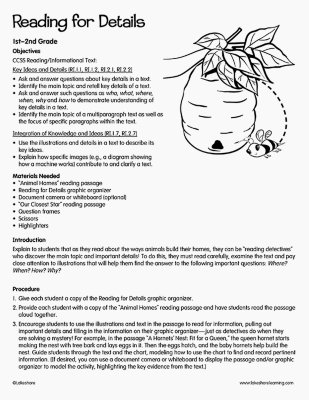
Reading for Details1st Grade - 2nd Grade
Objectives CCSS Reading/Informational Text: Key Ideas and Details (RI.1.1, RI.1.2, RI.2.1, RI.2.2) Ask and answer questions about key details in a text. Identify the main topic and retell key details of a text. Ask and answer such questions as who, what, where, when, why and how to demonstrate understanding of key details in a text. Identify the main topic of a multiparagraph text as well as the focus of specific paragraphs within the text. Integration of Knowledge and Ideas (RI.1.7, RI.2.7) Use the illustrations and details in a text to describe its key ideas. Explain how specific images (e.g., a diagram showing how a machine works) contribute to and clarify a text. Materials Needed “Animal Homes” reading passage Reading for Details graphic organizer Document camera or whiteboard (optional) “Our Closest Star” reading passage Question frames Scissors Highlighters Introduction Explain to students that as they read about the ways animals build their homes, they can be “reading detectives” who discover the main topic and important details! To do this, they must read carefully, examine the text and pay close attention to illustrations that will help them find the answer to the following important questions: Where? When? How? Why? View Lesson Plan