Animal Adaptations1st Grade - 2nd Grade
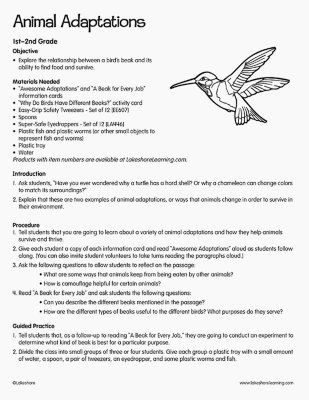
Objective Explore the relationship between a bird’s beak and its ability to find food and survive. Materials Needed “Awesome Adaptations” and “A Beak for Every Job” information cards “Why Do Birds Have Different Beaks?” activity card Easy-Grip Safety Tweezers - Set of 12 Spoons Super-Safe Eyedroppers - Set of 12 Plastic fish and plastic worms (or other small objects to represent fish and worms) Plastic tray Water Introduction Ask students, “Have you ever wondered why a turtle has a hard shell? Or why a chameleon can change colors to match its surroundings?” Explain that these are two examples of animal adaptations, or ways that animals change in order to survive in their environment. View Lesson Plan 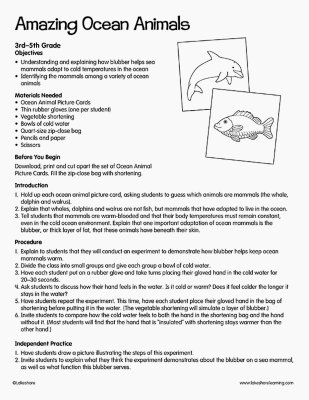
Amazing Ocean Animals3rd Grade
Objectives Understanding and explaining how blubber helps sea mammals adapt to cold temperatures in the ocean Identifying the mammals among a variety of ocean animals Materials Needed Ocean Animal Picture Cards Thin rubber gloves (one per student) Vegetable shortening Bowls of cold water Quart-size zip-close bag Pencils and paper Scissors Before You Begin Download, print and cut apart the set of Ocean Animal Picture Cards. Fill the zip-close bag with shortening. Introduction Hold up each ocean animal picture card, asking students to guess which animals are mammals (the whale, dolphin and walrus). Explain that whales, dolphins and walrus are not fish, but mammals that have adapted to live in the ocean. Tell students that mammals are warm-blooded and that their body temperatures must remain constant, even in the cold ocean environment. Explain that one important adaptation of ocean mammals is the blubber, or thick layer of fat, that these animals have beneath their skin. View Lesson Plan