What Is Equal?2nd Grade
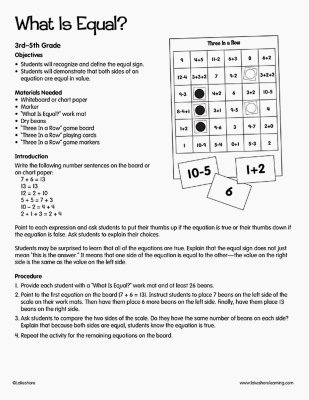
Objectives Students will recognize and define the equal sign. Students will demonstrate that both sides of an equation are equal in value. Materials Needed Whiteboard or chart paper Marker “What Is Equal?” work mat Dry beans “Three In a Row” game board “Three In a Row” playing cards “Three In a Row” game markers Introduction Write the following number sentences on the board or on chart paper: 7 + 6 = 13 13 = 13 12 = 2 + 10 5 + 5 = 7 + 3 10 - 2 = 4 + 4 2 + 1 + 3 = 2 + 4 Point to each expression and ask students to put their thumbs up if the equation is true or their thumbs down if the equation is false. Ask students to explain their choices. Students may be surprised to learn that all of the equations are true. Explain that the equal sign does not just mean “this is the answer.” It means that one side of the equation is equal to the other—the value on the right side is the same as the value on the left side. View Lesson Plan 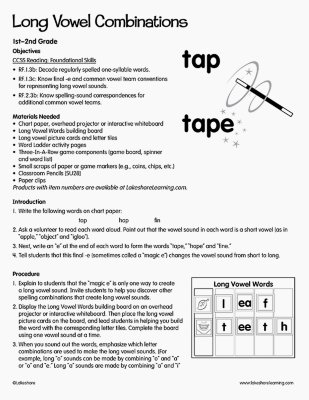
Long Vowel Combinations1st Grade - 2nd Grade
Objectives CCSS Reading: Foundational Skills RF.1.3b: Decode regularly spelled one-syllable words. RF.1.3c: Know final -e and common vowel team conventions for representing long vowel sounds. RF.2.3b: Know spelling-sound correspondences for additional common vowel teams. Materials Needed Chart paper, overhead projector or interactive whiteboard Long Vowel Words building board Long vowel picture cards and letter tiles Word Ladder activity pages Three-In-A-Row game components (game board, spinner and word list) Small scraps of paper or game markers (e.g., coins, chips, etc.) Classroom Pencils Paper clips Introduction Write the following words on chart paper: tap hop fin Ask a volunteer to read each word aloud. Point out that the vowel sound in each word is a short vowel (as in “apple,” “object” and “igloo”). Next, write an “e” at the end of each word to form the words “tape,” “hope” and “fine.” Tell students that this final -e (sometimes called a “magic e”) changes the vowel sound from short to long. View Lesson Plan Autumn Owls Beginning AdditionPre-K - Kindergarten
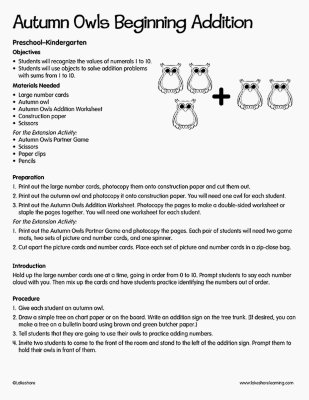
Objectives Counting & Cardinality Understand that the last number name said tells the number of objects counted. The number of objects is the same regardless of their arrangement or the order in which they were counted. Operations & Algebraic Thinking Solve addition and subtraction word problems, and add and subtract within 10, e.g., by using objects or drawings to represent the problem. Materials Needed Large number cards Autumn owl Autumn Owls Addition worksheet Construction paper Scissors Chart paper or whiteboard Bulletin board (optional) Stapler (optional) For the Extension Activity: Autumn Owls Partner Game Scissors Paper clips Pencils Zip-close bag Introduction Hold up the large number cards one at a time, going in order from 0 to 10. Prompt students to say each number aloud with you. Then mix up the cards and have students practice identifying the numbers out of order. View Lesson Plan Equivalent Fraction Activities3rd Grade
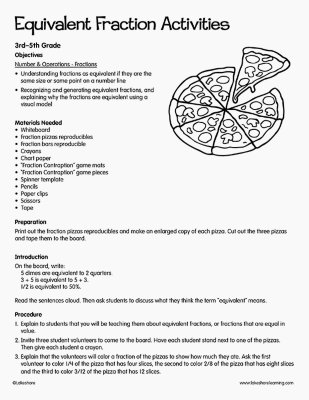
Objectives Number & Operations - Fractions Understanding fractions as equivalent if they are the same size or same point on a number line Recognizing and generating equivalent fractions, and explaining why the fractions are equivalent using a visual model Materials Needed Whiteboard Fraction pizzas reproducibles Fraction bars reproducible Crayons Chart paper “Fraction Contraption” game mats “Fraction Contraption” game pieces Spinner template Pencils Paper clips Scissors Tape Introduction On the board, write: 5 dimes are equivalent to 2 quarters. 3 + 5 is equivalent to 5 + 3. 1/2 is equivalent to 50%. Read the sentences aloud. Then ask students to discuss what they think the term “equivalent” means. View Lesson Plan 
Place Value Practice4th Grade
Objectives Number & Operations in Base Ten Reading and writing multi-digit whole numbers in number, name, and expanded form Comparing two multi-digit numbers based on meanings of the digits in each place, using >, =, and < Materials Needed Large number cards Place Value Playoff game mat Place Value Playoff number tiles Construction paper Scissors Chart paper (optional) Preparation: Print out the large number cards, photocopy them onto construction paper and cut them out. You will need two or three copies of each number. Introduction/Review Write 347 and 453 on the board. Ask students to tell you which number is greater. Then ask, “Which place value did you compare to know that this is true? Why?” Guide students to understand that they compared the hundreds place because it is the highest place value in both numbers. (For older students, bring up the level by writing 3,470 and 4,532 or 34,705 and 45,320.) Reinforce the concept by underlining the hundreds place in each number and telling students that four hundreds is greater than three hundreds. Now ask, “What if the numerals in the hundreds place are the same? Which number is bigger, 347 or 353?” Guide students to understand that they should compare the next highest place value—the tens place. View Lesson Plan